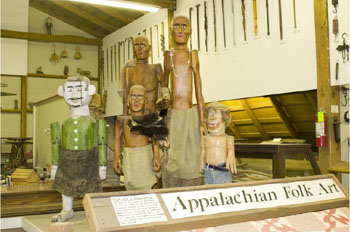
We invite you to visit the village, farm, and exhibits at the Museum of Appalachia. We are only one mile off of Interstate 75, but our picturesque pastures, historic 19th century buildings, and authentic old-time music will make you feel as if you've traveled back in time.
With more than 30 historic log buildings gathered onto 63 acres and hundreds of exhibits celebrating the creativity and color of our Appalachian forebears, the Museum annually hosts over 100,000 visitors who view thousands of relics in authentic settings. It was, in fact, founder John Rice Irwin's intention to develop the Museum as an authentic representation of early life in Appalachia, seeking to make the dwellings appear as if the family has just strolled down to the spring to fetch the day's supply of water.
In addition to hosting thousands of families, schoolchildren, weddings and reunions, basket collectors, and historians each year, the Museum celebrates the seasons with three special events:
|
|
Our annual fall festival, Tennessee Fall Homecoming, is one of the largest and
oldest music and crafts festivals in the Southeast. Now in its 30th year, Homecoming features traditional music and dancing, with craftsmen, cooks, and cloggers serving up four days of lively entertainment and authentic sights and sounds of the remote Southern Appalachians. |
Come join us rattle the windows and shake the hills with our July 4th Celebration and Anvil Shoot. We'll be demonstrating old-time mountain activities, and we always have something special planned for the children.
Museum plans unveiling of Sgt. York war relic!
It’s a rusty old machine gun, with tattered strap and battle-scarred wooden stock—not even very large by today’s standards. By itself, it’s not that impressive. But mention the name Sgt. Alvin C. York, and this war relic takes on special meaning.
It represents “the flag on the hill,” a brave deed by a backwoods soldier who remained cool under fire, silencing machine gun nests that were raining a firestorm of bullets on Allied troops. York was the leader of seven men who captured 132 German machine gunners on October 8, 1918, in the Battle of the Argonne Forest in northern France. For this heroic deed, York received the National Medal of Honor and became the most decorated soldier of World War I.
This M1908/15 Maxim light machine gun is documented as one of the German weapons confiscated on that day. This historic artifact will become the centerpiece of an already extensive exhibit at the Museum, revealing the man behind the medals—a simple and honest East Tennessee backwoodsman who used his fame to help others.
To introduce the exhibit, a special screening of the classic 1941 film “Sergeant York” will be held Sunday, Jan. 24, at the Tennessee Theatre in downtown Knoxville. The event begins at 3 p.m. with music by Dixie Gray, one of the Museum’s most requested bands, followed by showing of the movie at 3:30 p.m. Tickets are available at the Tennessee Theatre box office.
All proceeds will support the non-profit Museum’s mission to preserve the Appalachian history and culture.
A special exhibit at the Museum, beginning February 7 and running through March 31, will include items on loan from the York family. Moviegoers may show a ticket stub to receive half off the regular adult admission. To encourage parents to bring their children to see this historic display, children ages 6-12 will be admitted to the Museum free from Feb. 7 through March 31 when accompanied by an adult with a movie ticket stub.
Visitors may also tour the Museum, a replica of an Appalachian farm/village with dozens of historic log structures, thousands of authentic artifacts, gift shop and restaurant, and gardens and farm animals in a picturesque setting, surrounded by split-rail fences.
The Hall of Fame contains exhibits on both famous and ordinary Appalachians, including an extensive display on Sgt. York. The York exhibit portrays a man of large dreams and generous heart. It includes York’s favorite leather jacket, a cash register used by York in his country store, and other personal items that reveal the “man behind the hero.”
A rowdy turned pacifist who nevertheless “did his duty for his country,” York went to war reluctantly. On October 8, 1918, York was the highest ranking member of his squad after German machine guns opened deadly fire. To silence the machine gun nest, York worked his way into position. York wrote in his diary, published after the war: "And those machine guns were spitting fire and cutting down the undergrowth all around me something awful. And the Germans were yelling orders. You never heard such a racket in all of your life. I didn't have time to dodge behind a tree or dive into the brush… As soon as the machine guns opened fire on me, I began to exchange shots with them. There were over thirty of them in continuous action, and all I could do was touch the Germans off just as fast as I could. I was sharp shooting… All the time I kept yelling at them to come down. I didn't want to kill any more than I had to. But it was they or I. And I was giving them the best I had."
When all was over, York and his little band of seven men had captured 132 Germans and opened the way for continuation of the Allied attack. His commanding general, John J. Pershing, greeted him with the words: “Well, York, I hear you’ve captured the whole damned German army.” A photo and article in the Saturday Evening Post broke the news of this heroic action to the world—and to York’s family.
York returned to Fentress County after the war. For 20 years, he flatly refused to capitalize on his fame as a war hero. When World War II broke out, York was persuaded that it was his patriotic duty to permit a movie on his wartime exploits.
Uncomfortable with the mantle of war hero, York used his fame to help others. His greatest personal achievement was the Alvin C. York Institute, a public high school he founded in his home county. Semi-literate himself, he realized the value of education, and he did his best to bring it to this rural area.
He once said he wanted to be remembered for his efforts to improve education—but his name is tied forever to Gary Cooper’s iconic screen portrayal of a mountain hero and his exploits in the Argonne Forest in the closing days of World War I.
Museum of Appalachia receives ‘library’ of resources
Treasured artifacts at the Museum of Appalachia will be preserved for future generations with the aid of the Bookshelf Collection, a self-contained “library” awarded through a federal grant.
The Bookshelf Collection is a set of books, DVDs, and online resources donated by the Institute of Museum and Library Sciences, the primary source of federal funding for the nation’s museums and libraries, and its partner in the project, the American Association for State and Local History.
The Museum received this essential set of resources based on an application describing the need to preserve its thousands of authentic Appalachian artifacts. Topics covered in the Bookshelf materials include the philosophy and ethics of collecting, collections management, emergency preparedness, and conservation methods.
“These wonderful books and on-line resources will be in valuable in helping us care for the artifacts in our collections,” said Elaine Meyer, the Museum’s executive director. “We’re excited to have such thorough and up-to-date resources at our disposal.”
The IMLS launched the Bookshelf Collection grants in 2006 after a study documented a nationwide need for such resources. Some 3,000 sets will be awarded to museums nationwide by the end of 2009.
“According to a recent national survey, our important collections are at great risk, and without them, the American story simply cannot be told to future generations,” said Anne-Imelda Radice, IMLS director.
The Museum of Appalachia, founded in 1969 by John Rice Irwin, is a living history village with dozens of authentic log structures, exhibit buildings filled with thousands of historic Appalachian artifacts, gardens surrounded by split rail fences, and a variety of farm animals in a picturesque setting. A large craft and gift shop contains handiwork from area artisans, and a restaurant features fresh-from-the-garden produce and home-style desserts.
In 2003, the Museum was converted to a 501(c) (3) corporation; it now operates under a Board of Directors. In May 2007, the Museum announced its formal association with the Smithsonian Institution’s Affiliations Program. By purchasing a Museum membership, visitors can support the Museum’s mission while touring the Museum at no additional charge (except during the Tennessee Fall Homecoming). Smithsonian memberships are also available.