HOME INDEX EXHIBITIONS EVENTS ABOUT US BLOG LINKS CONTACT US SUBSCRIBE

Hansen Museum
Dane G. Hansen Memorial Museum

Logan, KS

SUPPORT OUR ADVERTISERS. THEY MAKE THIS SITE POSSIBLE
Premium Ad Space
Exhibition: The Science of SuperCroc
Dane G. Hansen Memorial Museum
P.O. Box 187
110 West Main Street
Logan, Kansas 67646
785-689-4846
Map

Email: hansenmuseum@ruraltel.net


Website: www.hansenmuseum.org

There is no admission fee!

Free Wi-Fi Hotspot in the Community Room!

Hours:

  • Monday - Friday:
    9AM until Noon and 1PM until 4PM
  • Saturday:
    9AM until Noon and 1 PM until 5PM
  • Sundays and Holidays:
    1 PM until 5 PM
  • (Closed on Thanksgiving, Christmas
    and New Years Day)

General Information
The Dane G. Hansen Memorial Plaza was conceived by the trustees of the Dane G. Hansen Foundation as a means of memorializing the Hansen Family in a way that would give Logan, Kansas, and the entire area, new cultural and social opportunities. The Foundation made a tremendous community improvement when it purchased and razed an entire square block of mostly unoccupied business buildings in downtown Logan to make room for the Memorial Plaza.

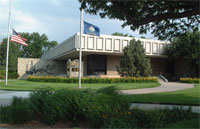
The five year project was completed in 1972 and deeded to the City of Logan. The Plaza was officially dedicated on April 10, 1973. The Plaza is a square block area, centered around a multipurpose building, and surrounded by beautiful landscaping. The building is designated into quadrants: one for the Trust and the Foundation; and one each for a Community Meeting Room, a Museum, and a Gallery. Designed by Kiene and Bradley of Topeka and built from pre-stressed concrete, the quadrants are divided by protruding sections of Neva Limestone, which was quarried near Junction City, Kansas. The building is fully carpeted and elegantly decorated, making it the finest structure of its type in the area.

The Plaza contains an all-purpose community room furnished with an organ, keyboard, a Kansas patchwork quilt from the Hansen Family, and paintings by Kansas artists. The Museum contains early American and foreign coins, European and Western guns, Mr. Hansen's office, the Hansen Family Biography, oriental art collected by Kate Hansen in Japan from 1907 to 1951, and art objects purchased by the Museum Association. The Museum also houses traveling exhibits and a monthly "Artist of the Month" exhibit.

Trustees of the Foundation have funded many projects which they felt met Mr. Hansen's intentions for the Foundation. Among these projects are: nursing and educational scholarships for students from Northwest Kansas, numerous cultural events, local and statewide educational programs and charitable projects, church building projects, and scouting. They paved the roads and installed a water system at the Logan Cemetery, provided funding for a local swimming pool and tennis courts, gave "seed money" for the construction of a low-cost housing project, built the Logan Medical Clinic, and support the Logan Nursing Home. The Foundation is one of the top contributing foundations in the State of Kansas.


Exhibition:

The Science of SuperCroc
August 13, 2010 through November 7, 2010

Created by:
Project Exploration
Chicago, Illinois

Fossil remains of one of the largest crocodilian species ever to live have been found in the Sahara by a team led by Paul Sereno, a professor at the Universtiy of Chicago and a National Geographic Explorer-in -Residence. The crocodile is believed to have reached 40 feet in length, comparable to the length of a city bus. The animal lived about 110 million years ago in what is now the windswept Tenere Desert in central Niger, home to Tuarg nomads and the richest dinosaur beds in Africa. Sereno's team came across the fossilized 6-foot-long jaws of a crocodilian soon after entering the region. They knew it was no dinosaur. "We had never seen anything like it," Sereno said. "The snout and teeth were designed for grabbing prey-fish, turtles and dinosaurs that strayed too close. This enormous reptile would have made Africa's ancient riverbanks a dangerous place, even for a dinosaur."

Sereno's 2000 expedition to Niger, funded in part by the National Geographic Society, went on to collect fossils from several individuals of the crocodilian, including about 50 percent of its skeleton. Nicknamed "SuperCroc,"the fossils belong to an extinct creature first discovered by French paleontologist Albert-Felix de Lapparent and named Sarcosuchus imperator ("flesh crocodile emperor") in 1966 by France de Broin and fellow palentologist Philippe Taquet. But until Sereno's recent discoveries, many questions about the beast lingered. "It was living an ambush lifestyle despite its enormous size, much of the time this animal was hiding 95% of it body under water" Sereno said. By measuring the bones and comparing them with those of modern crocs, Sereno has determined that a mature individual took as long as 50 to 60 years to reach an adult length of up to 40 feet and a weight of as much as 10 tons. Among the very largest crocs ever to have lived, Sarcosuchus evolved from a branch of the crocodilian family tree outside the group that gave rise to all living crocodiles. Besides Sarcosuchus, Sereno's discoveries in Niger include a 4-inch-long skull of a new species of dwarf crocodile. At least five species of crocodiles inhabited the area in the middle Cretaceous 110 million years ago, when broad rivers stretched across lush plains. Sarcosuchus was the monster among them, tangling with rivals including the sail-backed, fish-eating dinosaur Suchomimus, a species Sereno discovered on an earlier expedition. Sereno said people tend to have an inaccurate image of crocodile behavior and intelligence. "Some people think of them as dumb, clumsy, silent creatures," he said. "They are anything but clumsy, and they communicate extensively by calling, even roaring and splashing. It looks as if Sarosuchus did some of that too."

"The 2000 expedition, Sereno's fourth to the Sahara, scoured broad areas of desert that subjected the 17-person team to temperatures topping 125 degrees Fahrenheit. The logistics included moving trucks, tools, tents, five tons of plaster, 600 pounds of pasta, 4,000 gallons of water and four months' worth of other supplies into the world's largest desert.

To help breathe life into bones of the giant crocodile, Sereno joined forces with National Geographic reptile expert Brady Barr, traveling the globe to get a first-hand look at living crocodilians. Barr and Serenl's work - and the crocodilians they study - are the subject of a global television event on the National Geographic Channel.

Sereno joined the University of Chicago faculty in 1987, where he is a Professor in Organismal Biology & Anatomy. He teaches paleontology and evolution to graduate and undergraduate students and human anatomy to medical students. Through Project Exploration, an organization he co-founded in 1998, he also brings dinosaur discoveries and natural science to the public and provides innovative educational opportunities for city kids. Sereno has made a string of major discoveries in his work as a paleontologist, including the oldest dinosaur ever found (discovered in Argentina), the first dinosaur skull and skeletons found from the Cretaceous period in Africa, and from Niger, a new 27-foot-long predator and a 60-foot-long herbivore.

Support Your Local Galleries and Museums! They Are Economic Engines for Your Community.

Subscribe to Our Free Weekly Email Newsletter!

Advertise with this banner
BACK NEXT
Copyright 2010 Art Museum Touring.com